Take a moment to review some of the valuable work being done by recipients of both our discretionary and Citizenship and the Public Good grants!
Center for Ethics (Spring 2025)
RGSCP was pleased to provide funding to support the creation of the UNH Center for Ethics (CfE) as proposed by Assistant Professor of Philosophy Laure Barillas, Assistant Professor of Philosophy Claudi Brink, Associate Professor of Philosophy Timm Triplett, and Professor of Philosophy Nick Smith. CfE leverages UNH’s constellation of highly successful existing outreach, teaching, and research initiatives to expand those offerings. The Center was designed to take advantage of the remarkably active public philosophy community throughout New Hampshire and to serve our unique land grant R1 comprehensive research university.
One of the first programs hosted by the Center for Ethics was the Ethics Research Reading Group in the spring of 2025. CfE invited faculty from various USNH colleges and programs to discuss a published text of their choosing over three discussion sessions and culminating in a half-day workshop. A primary goal of the Ethics Research Reading Group was to build relationships between UNH faculty working in ethics and ethics-adjacent fields.
The Idea of Europe in a Transnational Germany (Spring 2025)
In the spring of 2025, Professor of German, Alex Holzienkemper invited award-winning author Mattias Nawrat to speak to his class, "The Idea of Europe in a Transnational Germany." Mr. Nawrat's work centers on his own experience as a German-Polish citizen who has keenly observed political and cultural developments in the EU’s eastward expansion and the shifts in contemporary (self-)understandings of Europe and Europeans. On the one hand, these developments show trends towards the removal of certain borders (e.g. for the movement of goods and peoples within the Schengen Area). On the other hand, we see the rising appeal of populist and nationalist rhetoric and parties all across Europe.
In this class, students explored various authors of bi-national German heritage (Polish-German, Croatian-German, Turkish-German, Ukrainian-German) with Mr. Nawrat’s book as their main reading from which they read selected chapters throughout the semester. His book offered nuanced reflections on the fluid definition of what counts as Europe and how the integration process of formerly Soviet-aligned countries is unfolding, especially in light of renewed Russian aggression.
How Democracies Die/Thrive (Fall 2024)
A theatrical exploration of the New York Times best-selling book by Steven Levitsky and Daniel Ziblatt, the play, devised by UNH students, delved into the book’s examination of how we have arrived at this moment in our democracy. As stated in the Wall Street Journal’s review; “The authors argue, with good evidence, that democracies aren’t destroyed because of the impulses of a single man; they are, instead, degraded in the course of a partisan tit for tat dynamic that degrades norms over time until one side sees an opening to deliver the death blow.” The result of more than twenty years of studying the breakdown of democracies from the 1930s to the present, the book’s authors have provided an artistic springboard to understand how democracies die, and how ours can not only be saved, but thrive.The play was part of a larger program, How Democracies Die/Thrive, that featured speakers and panels leading up to the production.
What can we learn from Claudine Gay?: The politics of citation, plagiarism, & the spread of ideas in the social sciences (Spring 2024)
This RGSCP-supported project focused on the development of an event that challenged participants to ask consider questions about plagiarism, citation, the transfer of ideas from one scholarly work to the next, and, more broadly, how we know what we know. The panel responded to the highly publicized resignation of Harvard President Claudine Gay, a political scientist by training, in the midst of numerous plagiarism allegations, as well as the conservative backlash against Gay’s testimony at a congressional hearing on rising anti-semitism on college campuses. Planning for the panel was led by the four faculty panelists/moderator (Profs. Emily Baer, Madhavi Devasher, and Jen Spindel from political science, and Prof. Eleta Exline from Dimond Library). The panelists drew on their own experience researching and publishing scholarly work in political science, as well as advising student research, to offer insights and raise questions about why some ideas are privileged (and cited) over others, the politics of citation, and how to prevent – and respond to – plagiarism allegations in your own work.
Teach-In on Labor Unions (Fall 2023)
Organized by an interdisciplinary group from UNH’s History, Sociology, Education, Classics, History, and Italian Studies departments, plus AAUP-UNH, this Teach-In drew on the expertise and experiences of the speakers to provide students and the public with a thoughtful discussion of the role of organized labor in local and national context.
Several UNH faculty and union members spoke at the Teach-In, including Prof. Cliff Brown, Prof. Robert Ford (UNH Law), and Prof. Catherine Moran. In addition, three invited speakers from outside UNH shared their expertise: Prof. Aviva Chomsky of Salem State University (MA), Prof. Steve Striffler of UMASS Boston; and Prof. Maryanne Trasciatti of Hofstra University.
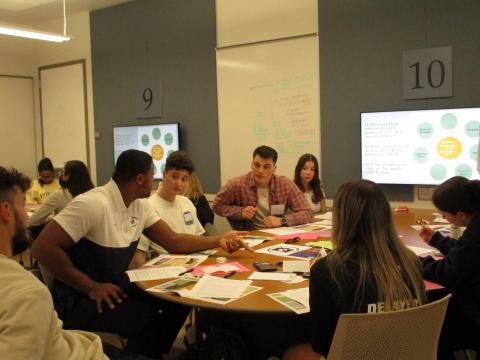
After the panel presentations, there was ample Q & A from the audience and, at the end of the event, discussion circles were facilitated by Prof. Jen Borda of the Civil Discourse Lab.
Civil Discourse Lab for Collaborative Leadership and the Public Good (Spring 2023, ongoing)
Since this grant was awarded to Professors of Communication Jennifer Borda and Renee Heath in February 2023, the Civil Discourse Lab for Collaborative Leadership and the Public Good has initiated greater cultural transformation around civil discourse, public dialogue and deliberation on the UNH campus. The recipients used this funding to plan and execute a staged roll out that expanded opportunities for student involvement in civil discourse (design, approval, and launch of two new two-credit classes in 2024-2025), created new opportunities for engaged research fellows (inaugural CIRCLE Engaged Fellow announced April 2024), and developed sustainable curricula around collaborative leadership and public engagement in a professional development program for the greater New Hampshire community (CDL Bootcamp in August 2024). This new version of the Civil Discourse Lab significantly advances the goals of RGSCP by teaching, modeling, and researching the benefits of a dialogic ethic to citizenship and the public good. Professor Borda and Professor Heath assert that an ethic of dialogue, which is grounded in building understanding across differences on some of the most perplexing issues in civic society, is the cornerstone of civil discourse and citizenship. They see this as an opportunity to re-orient the public land grant mission by bringing students, faculty, and the community collectively into a space of learning, and providing the resources and capacity necessary to ask big questions, intervene into thorny problems, and collaborate with one another on issues of civic relevance.
